Content model
On this page 7
All authored content lives in app/Support/content/. Three modules, each with
a documented shape, published into the database by buddy catalog:sync.
features.ts
The capability catalog. 18 entries, each one a FeatureContent.
export interface FeatureContent {
  slug: string
  name: string
  category: 'detect' | 'act' | 'operate'
  /** One line, sentence case, used under the name in menus and cards. */
  tagline: string
  /** Under 25 words. Card body and meta description. */
  summary: string
  /** What it costs a farm today. Two or three sentences, concrete. */
  problem: string
  /** How the system does it. Three or four steps. */
  steps: { title: string, text: string }[]
  /** Instruments the flight actually carries for this job. */
  sensors: string[]
  /** What lands in the farmer's hands afterwards. */
  outputs: string[]
  /** How often this job is normally flown. */
  cadence: string
  /** Dashboard readings this capability produces. Measurements, not promises. */
  readings: string[]
  /** Use case slugs where this capability does the most work. */
  useCases: string[]
  /** Sort order inside its category. */
  order: number
}
Two fields deserve emphasis because they are what keeps the copy honest.
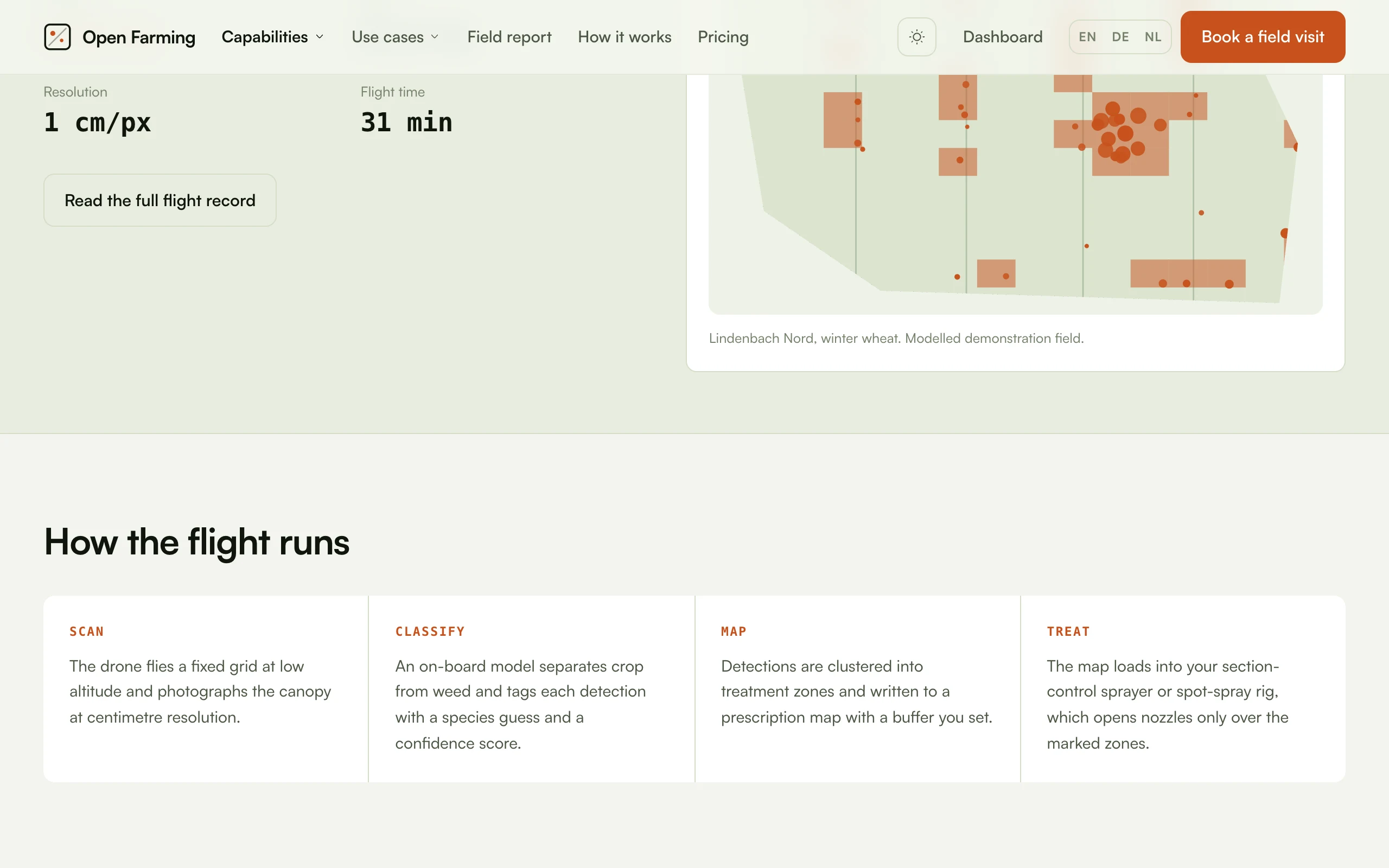
That section is steps[] rendered in order, and the flight statistics above it
come from the Mission row rather than from the copy. Editing the array
changes the page, the API and the share card together.
readings are measurements, not promises. "Treated area as a share of
field area" is a reading. "Save 70% on herbicide" is not, and does not belong
in this file. Every reading here is something the dashboard can actually
compute from a flight record.
sensors are the instruments the flight actually carries. Two capabilities
declare that they carry none:
Sustainability reporting and
Field decision assistant both say "no flight of
its own", because they consume other capabilities' output. Do not invent a
payload for a capability that does not fly.
Helpers: featureBySlug(slug), featuresByCategory(category), and the
featureCategories record that supplies each group's label and blurb.
use-cases.ts
16 entries, each a UseCaseContent. A use case is deliberately not a
feature list. It answers three questions a grower asks before anything else:
what goes wrong on this crop, what the flight calendar looks like across a
season, and which capabilities carry the weight.
export interface UseCaseContent {
  slug: string
  name: string
  segment: 'arable' | 'permanent' | 'protected' | 'livestock' | 'operator'
  tagline: string
  summary: string
  /** What actually goes wrong on this crop or operation. */
  challenge: string
  /** How the platform is normally set up for it. */
  approach: string
  /** The flight calendar across a season. */
  season: { window: string, focus: string }[]
  /** Feature slugs, most load bearing first. */
  features: string[]
  /** What the operation gets out of it, stated as measurements. */
  outcomes: string[]
  /** Typical field or block size this is set up for. */
  scale: string
  order: number
}
features is ordered: most load bearing first. UseCaseShowAction resolves
them in exactly that order, so the ordering is visible to every consumer.
The cross-reference rule
features[].useCases and useCases[].features both hold slugs of the other
file's entries. catalog:sync validates that every cross-reference
resolves before it writes anything. A rename in one file that is not mirrored
in the other fails the sync rather than silently producing a dead link.
UseCaseShowAction also drops an unresolvable slug rather than emitting a
null, so if one ever got through, a consumer would see a shorter list and not
a hole in it.
demo-field.ts
The demonstration field: one farm, one field, one weed-mapping flight, its detections, and the prescription that came out of it.
It is generated rather than hand-listed, because the interesting property is the spatial structure. Weed pressure on a cereal field is not scattered evenly. This module reproduces the three sources explicitly:
| Source | Count | Shape |
|---|---|---|
| Headland band | 34 detections | A ring inside the boundary, heaviest on the two short ends where the sprayer turns |
| Tramline corridors | 36 detections | Four narrow lanes at x = 0.24, 0.42, 0.61, 0.79, running the length of the field |
| Established patches | 28 detections | Two elliptical clusters, the kind that come back in the same place |
Generation is deterministic: a fixed-seed mulberry32 PRNG, no Date, no
Math.random. Seed 20260726. The same field comes out on every machine, so
the seeded database, the API and the rendered SVG always agree, and a reseed
never silently changes a figure quoted in the copy.
The published figures
| Figure | Value |
|---|---|
| Field | Lindenbach Nord, winter wheat, 24.6 ha |
| Farm | Hofgut Lindenbach, Niederbayern, 268 ha |
| Detections | 98 |
| Species | Blackgrass 38, Chickweed 25, Cleavers 23, Charlock 12 |
| Severity | 50 low, 36 medium, 12 high |
| Treatment zones | 62 |
| Treated area | 4.34 ha, 17.6% of the field |
| Prescribed rates | 110, 140 and 180 l/ha by zone weight |
How the prescription is derived
demoZones() is deliberately the same logic the product describes on the
feature page:
- Detections are binned onto a 16 by 22 grid.
- A cell whose total weed area reaches 150 m² is switched on. Below that, opening the nozzle is not justified.
- Each live cell gets a rate by weight: over 1,400 m² takes the full 180 l/ha, over 600 m² takes 140, the rest take 110.
The grid is coarse on purpose. It is what a boom's section control can actually resolve, so a prescription finer than that would be a map no machine could follow. See Prescriptions for the production version of this step.
The boundary (DEMO_BOUNDARY) is a nine-point ring rather than a rectangle,
because a real block has a kink where it follows a track and a corner taken out
by a copse.
Making a content edit
- Edit the module in
app/Support/content/. - Run
./buddy catalog:sync. - If you added a feature or a use case, add the cross-references on both sides, or the sync will refuse.
- If you added a capability, add a page under
docs/features/too. The dashboard lists every marketed capability whether or not a farm has switched it on, so an undocumented one becomes visible immediately.
A deploy runs catalog:sync automatically, so content edits ship with the
code and need no separate step.